Volatility moves with the price
In a sharp fall, implied volatility tends to rise. The crash band raises it as the price falls, so short options are priced the way a crash reprices them.
Switch on the crash band and Trident prices the trade through a market fall with implied volatility rising, calibrated on 71 index crash sessions.
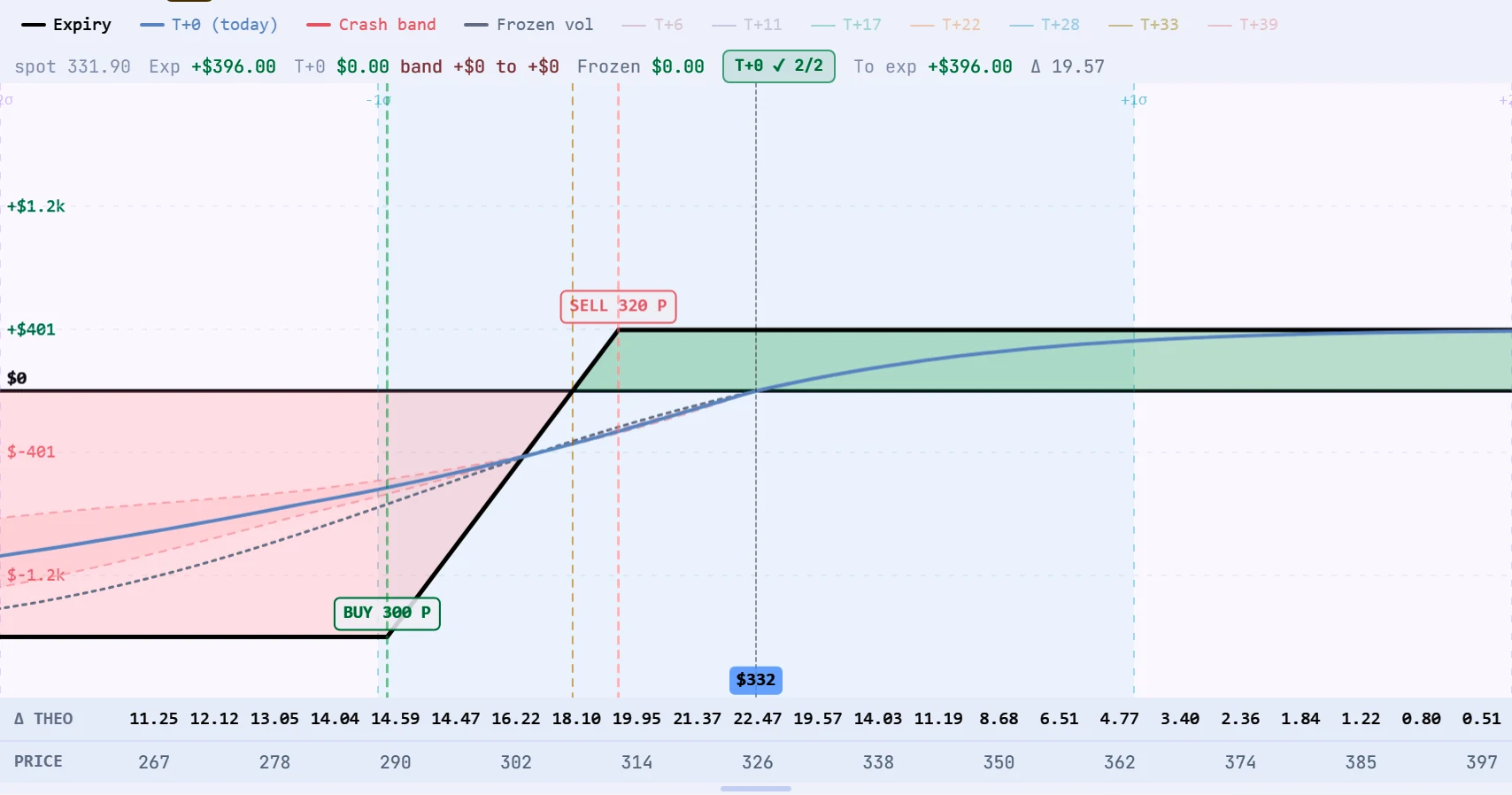
In a sharp fall, implied volatility tends to rise. The crash band raises it as the price falls, so short options are priced the way a crash reprices them.
The relationship between the fall and the rise in volatility comes from 71 index crash sessions.
Compare the quiet-fall curve with the crash curve before you choose the number of contracts.
The normal curve holds implied volatility fixed. The crash curve lets it rise as the price falls. The gap between them is the extra risk a crash adds.
Use it on a single strategy in the lab, a screener result, or the whole book across accounts.

Live terminal screens; prices are for illustration.
No. It is a scenario: what the position would be worth if a fall like those in the sample happened. It does not say how likely a crash is.
Overnight gaps beyond the sample, trading halts, wide bid-ask spreads and liquidity drying up. Treat it as one view of risk, not the only one.
Yes. It is a switch under the graph, off by default.